
World
Grief in Hong Kong: Fire Tragedy Raises Questions and Tensions

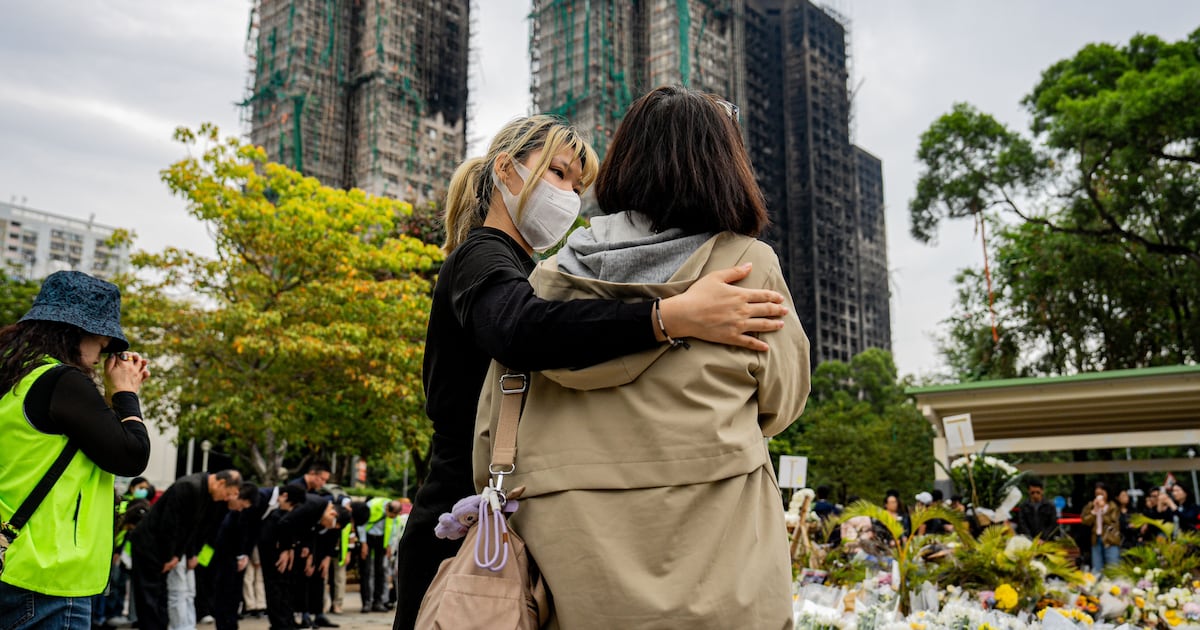
A devastating fire at the Wang Fuk Court complex in Hong Kong has resulted in a rising death toll, which now stands at **151**. Authorities are grappling with public outcry and grief, raising critical questions about the circumstances surrounding the tragedy and the government’s accountability. This incident comes at a time when Beijing faces challenges in managing public sentiment, particularly in a city where internet and social media remain relatively free compared to mainland China.
In the wake of the fire, thousands flocked to the site, forming a queue that stretched two kilometres to lay flowers and messages of sympathy. This outpouring of grief is reminiscent of the largest unauthorized assembly since the **2019 pro-democracy protests**. The swift organization of community support for survivors, primarily through social media platforms, reflects a robust civil society that operates independently of government directives.
As investigations into the fire unfolded, it became evident that warnings regarding hazardous materials in the complex were ignored. Additionally, the scrutiny of contracts for extensive renovations has heightened concerns about negligence. A spokesperson for the Beijing government’s national security office in Hong Kong remarked, “A small handful of external hostile forces are exploiting a disaster to stir up trouble and taking advantage of a crisis to create chaos.” The statement emphasized that all actions deemed disruptive would be monitored under Hong Kong’s national security laws.
Reports indicate several arrests have been made for alleged sedition related to public comments about the fire. Furthermore, a planned press conference by civil society groups was abruptly canceled following a notification from the authorities. Despite these measures, Hong Kong’s leadership, including Chief Executive **John Lee**, has engaged with journalists, a practice that starkly contrasts with the often opaque communication methods employed in mainland China.
Yan Zhihua, a research fellow at Nanjing University’s Zijin media think tank, highlighted the difference in crisis communication between Hong Kong and the mainland. He noted that Hong Kong officials provided immediate updates after the fire, meeting public expectations during a crisis. In contrast, mainland officials typically remain hidden after major incidents, relying on impersonal, text-based announcements to convey information. Yan stated, “In the mainland, public events almost invariably start and end on the internet. Online information shapes public opinion, while the offline world becomes secondary.”
He further pointed out that Hong Kong’s civil society played a crucial role in disseminating information post-fire, with community groups collaborating with the government without direct oversight. This partnership allowed for a more nuanced response to the tragedy, contrasting sharply with the mainland’s predominance of online discourse, where public sentiment can quickly escalate into demands for accountability.
As Hong Kong prepares for elections to the Legislative Council on **March 15, 2024**, the government is proceeding “out of respect for the constitutional order.” Of the council’s **90** members, **20** will be directly elected by voters, while others will be chosen through an election committee and industry groups. Candidates must demonstrate loyalty to Beijing, effectively sidelining pro-democracy parties that have either dissolved or been forced to disband.
Despite the political climate, Hong Kong’s stock exchange is experiencing a surge, with capital returning to the city following years of uncertainty due to the crackdown on protests and the enforcement of stringent national security laws. While political dissent has been largely quashed, personal freedoms remain, along with an environment conducive to business growth.
The aftermath of the Wang Fuk Court fire has highlighted the complexities of public sentiment in Hong Kong, raising significant questions about governance, accountability, and the balance of civil liberties. As the city navigates this challenging landscape, the impact of the tragedy will likely resonate in both political and social spheres for some time to come.

Donegal Hero Receives National Bravery Award for Life-Saving Rescue

Taxi Drivers Launch Urgent Protest in Galway Next Week

WPP Media Unveils Irish Language Advertising’s Dependency Dilemma

Rory McIlroy Eyes Comeback at Crown Australian Open

Nigel Farage Faces Growing Racism Allegations at Press Conference

Irishman James Graham Honored for Valor at Waterloo Battle

Ireland Joins Global Crackdown on Tax Evasion for Foreign Properties

Discover Ireland’s Rich Mythology: Legends and Folklore Explored

Irish Hero James Graham Honored as Bravest at Waterloo Battle

Tributes Surge for 9-Year-Old Leon Briody After Cancer Battle

Aimee Osbourne Joins Family for Emotional Tribute to Ozzy

Danny Healy-Rae Considers Complaint After Altercation with Garda

Ireland Enjoys Summer Heat as Hurricane Erin Approaches Atlantic

Hawaii Commemorates 80 Years Since Hiroshima Bombing with Ceremony

Newcastle West Woman Patricia Foley Found Safe After Urgent Search

Fianna Fáil TDs Urgently Consider Maire Geoghegan-Quinn for Presidency

Couple Convicted of Murdering Two-Year-Old Grandson in Wales

Gaza Aid Distribution Tragedy: 20 Killed Amid Ongoing Violence
-
 Top Stories3 months ago
Tributes Surge for 9-Year-Old Leon Briody After Cancer Battle
-
 Entertainment4 months ago
Aimee Osbourne Joins Family for Emotional Tribute to Ozzy
-
 Politics4 months ago
Danny Healy-Rae Considers Complaint After Altercation with Garda
-
 Top Stories4 months ago
Ireland Enjoys Summer Heat as Hurricane Erin Approaches Atlantic
-
 World5 months ago
Hawaii Commemorates 80 Years Since Hiroshima Bombing with Ceremony
-
 Top Stories3 months ago
Newcastle West Woman Patricia Foley Found Safe After Urgent Search
-
 Top Stories5 months ago
Fianna Fáil TDs Urgently Consider Maire Geoghegan-Quinn for Presidency
-
 World5 months ago
Couple Convicted of Murdering Two-Year-Old Grandson in Wales
-
 World5 months ago
Gaza Aid Distribution Tragedy: 20 Killed Amid Ongoing Violence
-

 World5 months ago
Aristocrat Constance Marten and Partner Convicted of Infant Murder
-

 Top Stories4 months ago
Climbing Errigal: A Must-Do Summer Adventure in Donegal
-

 Top Stories4 months ago
Hike Donegal’s Errigal Mountain NOW for Unforgettable Summer Views