
Politics
Ukrainian Children Share Harrowing Abduction Experiences in Rome

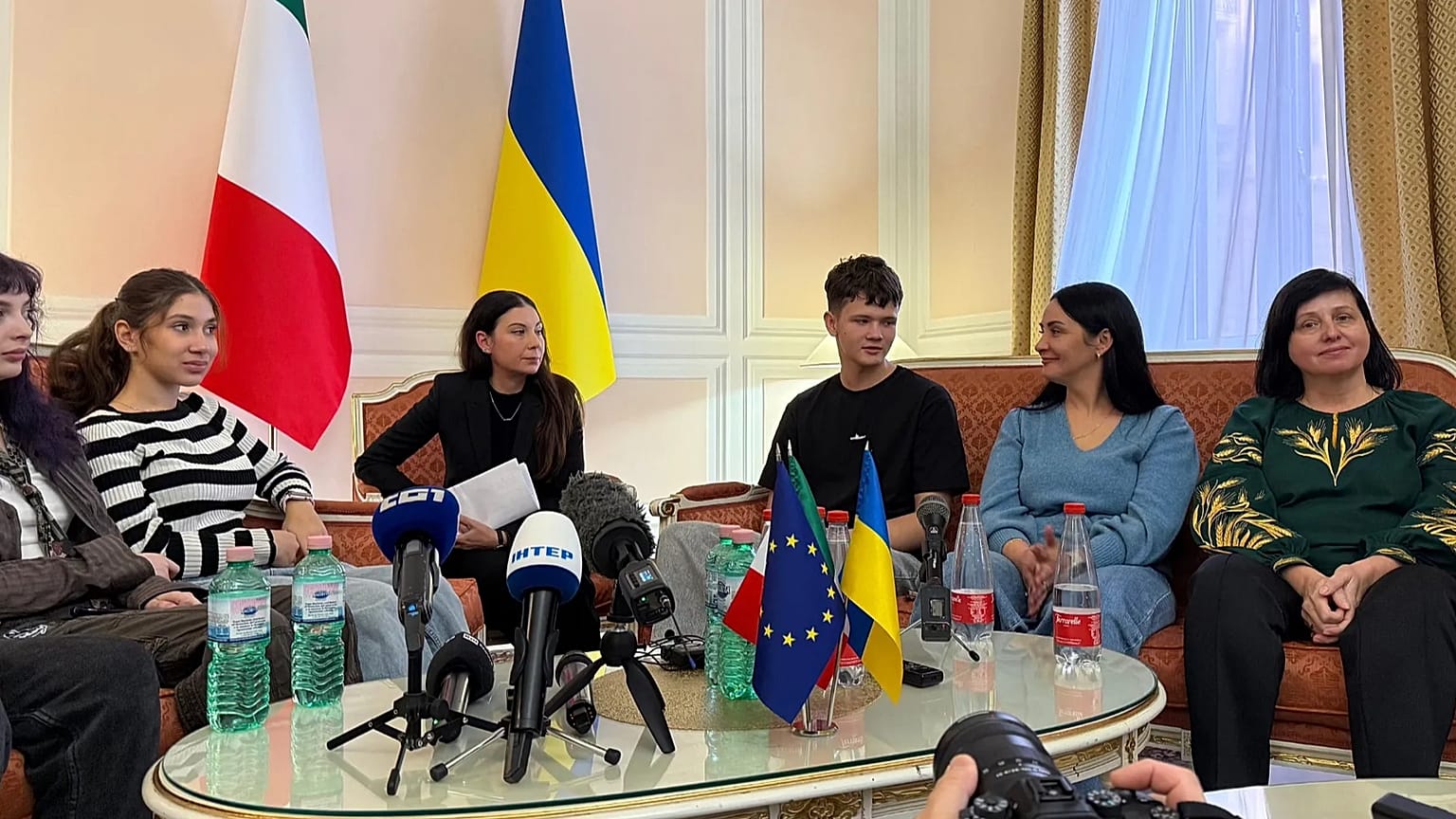
A delegation of Ukrainian children, once abducted by Russian forces, shared their harrowing experiences during a press conference in Rome on Wednesday. This event marked the first public gathering of these children since Russia’s full-scale invasion of Ukraine began in early 2022. Accompanied by their grandparents and relatives, these adolescents, aged 14 to 18, detailed the traumatic conditions they endured while in captivity, revealing the grim realities of Russia’s actions in Ukraine.
During the press conference held at the Ukrainian Embassy in Rome, a senior official from President Volodymyr Zelenskyy‘s office announced Ukraine’s intention to formalise the Vatican’s role as a mediator in negotiations for the release of civilians. The event was coordinated by Bring Kids Back Ukraine, a program launched by Zelenskyy to facilitate the return of abducted children to their home country. Since the invasion began, approximately 1,600 children have been safely repatriated to Ukrainian-controlled territory.
The testimonies given by the children revealed a systematic effort by Russian authorities to re-educate and assimilate Ukrainian youth. Reports indicate that these efforts often involve propaganda, indoctrination, and even torture. According to Bring Kids Back Ukraine, the aim of these operations is to alter the demographic makeup of Russian-occupied areas or to train young Ukrainians as future soldiers.
The scale of this issue is alarming. Eleonora Mongelli, vice president of the Italian Federation for Human Rights, confirmed that around 1.6 million Ukrainian children remain under Russian control. Ukrainian authorities have documented over 19,500 cases of child abductions since the beginning of the invasion, with estimates from Yale’s Humanitarian Research Lab suggesting that the actual number may be closer to 35,000 as of March 19, 2025. In contrast, Russia’s Children’s Rights Commissioner Maria Lvova-Belova asserted that her country “accepted” 700,000 Ukrainian children between February 2022 and July 2023.
Experiences in Filtration Camps
Many of the children recounted their experiences in “filtration camps,” facilities used by Russian authorities to interrogate and screen Ukrainians in occupied territories. These camps have been in operation since the early days of the invasion and serve as critical checkpoints. Families often face separation during the filtration process, causing immense distress.
Yuliia Dvornychenko, who spent two years in Russian-occupied areas, shared her story: “They check for tattoos to see if you carry any Ukrainian symbols. They also go through your phone to see if you have photos or phone numbers of soldiers — anything connected to Ukraine.” The consequences of failing these checks can be severe, including imprisonment.
The personal account of Liudmyla Siryk highlights the deep emotional scars left by captivity. Following a shelling incident in Mariupol in 2022, her grandson, Oleksandr, was captured by Russian forces. During the filtration process, he was separated from his mother and taken to occupied Donetsk before being reunited with his grandmother.
Another poignant story is that of Veronika Vlasova, who was taken to an orphanage in Russia after fleeing her village in the Kherson region at the age of 13. Vlasova described her experience in a filtration camp, where she faced bullying for being Ukrainian. “I was forced to tell them I loved Russia, otherwise they would have beaten me,” she recounted. After being separated from her aunt, she spent two weeks in isolation at an orphanage, leading to lasting psychological trauma.
Long-Term Psychological Effects
The long-lasting effects of these abductions remain a significant concern. Maksym Maksymov, head of projects at Bring Kids Back Ukraine, emphasized that the real issue transcends the number of children repatriated; it encompasses their psychological well-being post-captivity. “The Russian Federation wants to ensure that children are taught certain ‘truths’ about the world, leaving them vulnerable and disoriented,” he explained.
Despite efforts to provide psychological support, many children continue to grapple with the aftermath of their experiences. “They become extremely obedient, as if they’ve lost their free will altogether,” noted Maksymov.
In a further effort to address these issues, Iryna Vereshchuk, deputy head of Zelenskyy’s office, spoke of Ukraine’s desire for the Vatican to act as a formal mediator with Russia. A letter from Zelenskyy was delivered to Pope Leo XIV ahead of a scheduled meeting, seeking to formalise the humanitarian initiatives previously initiated by late Pope Francis.
Vereshchuk stated, “To be able to achieve more, we need to formalise this process in the Vatican. This is why the request now comes officially.” As these stories unfold, the plight of Ukrainian children remains a critical focus, underscoring the far-reaching impact of the ongoing conflict.

Man Appeals Conviction in Dublin Park Strangulation Case

Man Appeals Conviction for Attempted Strangulation in Dublin

Extended Christmas Public Transport Services Launch Across Dublin

George Clooney Reflects on Family and Directing in New Film

Empowering Teens: Transforming Anxiety into Self-Belief

RSA Urges Caution on E-Scooter Gifts for Children This Christmas

Inquiry Reveals Fisheries Agency Allowed False Insurance Claims

Urgent Warning: E-Scooters Top Cause of Child Brain Injuries

Galway Man Sentenced to 1 Year for Disturbing Child Abuse Material

Tributes Surge for 9-Year-Old Leon Briody After Cancer Battle

Aimee Osbourne Joins Family for Emotional Tribute to Ozzy

Danny Healy-Rae Considers Complaint After Altercation with Garda

Ireland Enjoys Summer Heat as Hurricane Erin Approaches Atlantic

Hawaii Commemorates 80 Years Since Hiroshima Bombing with Ceremony

Newcastle West Woman Patricia Foley Found Safe After Urgent Search

Fianna Fáil TDs Urgently Consider Maire Geoghegan-Quinn for Presidency

Couple Convicted of Murdering Two-Year-Old Grandson in Wales

Gaza Aid Distribution Tragedy: 20 Killed Amid Ongoing Violence
-
 Top Stories3 months ago
Tributes Surge for 9-Year-Old Leon Briody After Cancer Battle
-
 Entertainment4 months ago
Aimee Osbourne Joins Family for Emotional Tribute to Ozzy
-
 Politics4 months ago
Danny Healy-Rae Considers Complaint After Altercation with Garda
-
 Top Stories4 months ago
Ireland Enjoys Summer Heat as Hurricane Erin Approaches Atlantic
-
 World5 months ago
Hawaii Commemorates 80 Years Since Hiroshima Bombing with Ceremony
-
 Top Stories3 months ago
Newcastle West Woman Patricia Foley Found Safe After Urgent Search
-
 Top Stories5 months ago
Fianna Fáil TDs Urgently Consider Maire Geoghegan-Quinn for Presidency
-
 World5 months ago
Couple Convicted of Murdering Two-Year-Old Grandson in Wales
-
 World5 months ago
Gaza Aid Distribution Tragedy: 20 Killed Amid Ongoing Violence
-

 World5 months ago
Aristocrat Constance Marten and Partner Convicted of Infant Murder
-

 Top Stories4 months ago
Climbing Errigal: A Must-Do Summer Adventure in Donegal
-

 Top Stories4 months ago
Hike Donegal’s Errigal Mountain NOW for Unforgettable Summer Views