
Lifestyle
Young Scientists Showcase Innovation at Technology Exhibition

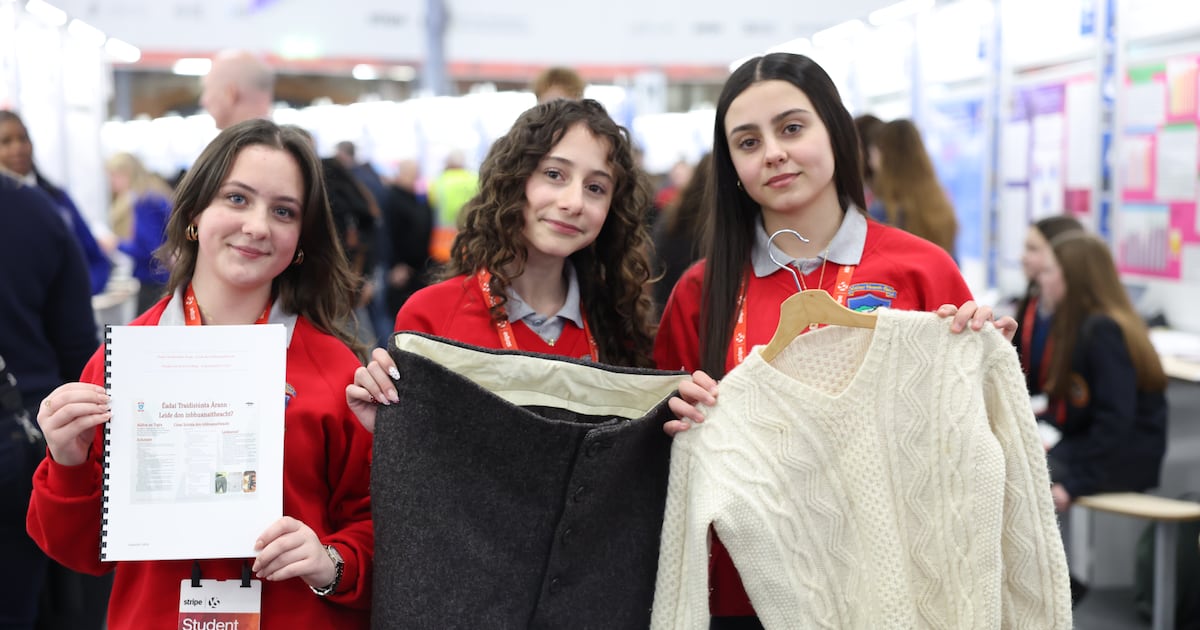
Students from across Ireland are showcasing their innovative projects at the Young Scientist and Technology Exhibition, held in January 2023. Among the entries, a notable project by Ailbhe de Blácam and her classmates from Coláiste Naomh Eoin on Inis Meain highlights the sustainability of clothing made from natural fibres compared to fast fashion.
Ailbhe presented an Aran jumper that her uncle wore on his First Communion day, emphasizing its durability. “It’s almost perfect,” Ailbhe noted, pointing out how the jumper has maintained its shape and colour over 35 years of wear. In contrast, she critiqued modern fast fashion items, stating, “That’ll barely last a year – and in 35 years, it could still be in a landfill, not decomposing because it’s made of plastic fibres.”
The project revealed that the Aran jumper, alongside a pair of 50-year-old woollen trousers, scored significantly higher in sustainability tests than their synthetic counterparts. Ailbhe, Laylabelle Ní Chléirigh, and Michelle Ní Fhátharta, all connected to the local knitting company, discovered that investing in quality, natural fibre items could be economically beneficial. “Even financially, you’re better off buying a few good items of wool or natural fibres,” Laylabelle said, reflecting on their findings.
Exploring Environmental Issues Through Innovation
The exhibition features 550 finalist entries, with a strong focus on topical issues. Students are tackling various subjects, including the competitive advantages of different clothing styles, the psychological effects of water quality, and the potential of AI-powered early flood-warning systems.
Emma Harmon, along with classmates Keelynn Keogh and Aimee O’Reilly from Scoil Chonglais in Co Wicklow, took inspiration from everyday waste. They observed that while compostable items like apple cores decompose, the plastic labels attached to them do not. In response, they developed biodegradable stickers using cornflour, glycerol, vinegar, and water, combined with a glue made from porridge and biodegradable ink.
Additionally, they replaced nylon string bags traditionally used for fruits and vegetables with alternatives made from nettle fibres. “The EU is banning single-use plastics in packaging on fruit and vegetables in 2030, so there’s only four years to find alternatives. Well, we have them here,” Aimee stated confidently.
Student Innovations in Science and Technology
Other students, like Jarlath Wruck from Meán Scoil Nua an Leith-Triuigh in Co Kerry, are pushing boundaries further. After constructing his own radio telescope last year, Jarlath is now using AI to profile dark matter halos from galaxy rotation curves, which he describes as “mapping the invisible.” He explained that his research aims to identify the forces shaping galaxies, satisfying humanity’s innate curiosity about the universe.
“There’s a psychological element to it,” he elaborated. “Humankind always wants to know how the Earth was formed and how the universe works. Hopefully, I can help accelerate understanding and feed that hunger for knowledge.”
As the exhibition continues, the projects on display reflect a commitment to addressing environmental challenges and advancing scientific understanding. The creativity and dedication shown by these young scientists underscore the potential for innovation in tackling pressing global issues.

Mother Reveals Daughter’s Meningitis Seizure After Night Out

Major Oil Spill Disrupts Traffic in Donegal on March 16, 2026

Discovering Literature: The Joys of Rejoining a Public Library

Ted Season 2 Announced: Release Date & Trailer Updates Revealed

Research Ireland and UKRI Forge New Collaboration Agreement

David McGoldrick’s Impressive Scoring Streak Sparks World Cup Talk

Plane Crash Claims Lives of Publishing Heir, Pregnant Wife, and Pilot

Oscars Snub Brigitte Bardot Sparks Controversy Over In Memoriam

Meta Plans Major Layoffs to Offset Rising AI Investment Costs

Tributes Surge for 9-Year-Old Leon Briody After Cancer Battle

Aimee Osbourne Joins Family for Emotional Tribute to Ozzy

Danny Healy-Rae Considers Complaint After Altercation with Garda

Hawaii Commemorates 80 Years Since Hiroshima Bombing with Ceremony

Ireland Enjoys Summer Heat as Hurricane Erin Approaches Atlantic

Couple Convicted of Murdering Two-Year-Old Grandson in Wales

Gaza Aid Distribution Tragedy: 20 Killed Amid Ongoing Violence

Newcastle West Woman Patricia Foley Found Safe After Urgent Search

Fianna Fáil TDs Urgently Consider Maire Geoghegan-Quinn for Presidency
-
 Top Stories11 months ago
Tributes Surge for 9-Year-Old Leon Briody After Cancer Battle
-
 Entertainment12 months ago
Aimee Osbourne Joins Family for Emotional Tribute to Ozzy
-
 Politics1 year ago
Danny Healy-Rae Considers Complaint After Altercation with Garda
-
 World1 year ago
Hawaii Commemorates 80 Years Since Hiroshima Bombing with Ceremony
-
 Top Stories12 months ago
Ireland Enjoys Summer Heat as Hurricane Erin Approaches Atlantic
-
 World1 year ago
Couple Convicted of Murdering Two-Year-Old Grandson in Wales
-
 World1 year ago
Gaza Aid Distribution Tragedy: 20 Killed Amid Ongoing Violence
-
 Top Stories11 months ago
Newcastle West Woman Patricia Foley Found Safe After Urgent Search
-
 Top Stories1 year ago
Fianna Fáil TDs Urgently Consider Maire Geoghegan-Quinn for Presidency
-

 World1 year ago
Aristocrat Constance Marten and Partner Convicted of Infant Murder
-

 Top Stories12 months ago
Climbing Errigal: A Must-Do Summer Adventure in Donegal
-

 Top Stories12 months ago
Hike Donegal’s Errigal Mountain NOW for Unforgettable Summer Views