
Science
Robotic Hand Detaches, Crawls, and Grabs Objects in New Breakthrough

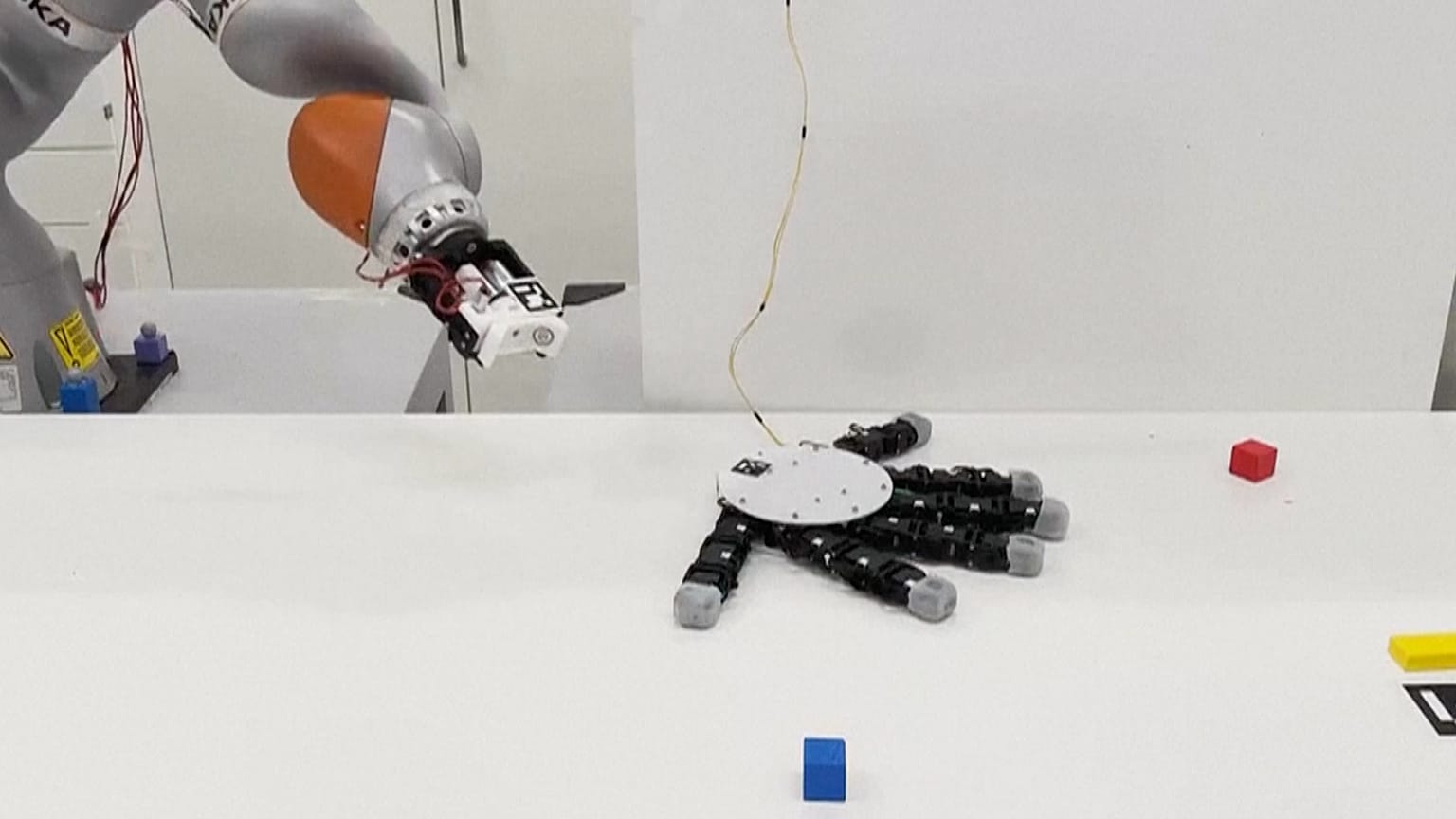
A groundbreaking development in robotics showcases a hand that can detach from its arm, crawl independently, and retrieve objects before reattaching itself. This innovative design, detailed in the journal Nature Communications, represents a significant leap in robotic functionality, enabling the hand to mimic over 30 common human grasp types and lift items weighing up to two kilograms.
The research team, led by Kunpeng Yao, an assistant professor at the University of Leeds in the UK, recognizes the limitations of traditional robotic hands that seek to replicate human anatomy. “We think the human hand is not perfect,” Yao stated. “We have a lack of symmetry in the hand, and the hand can only perform a limited number of tasks due to its structure.” The team’s objective was to explore how to enhance robotic dexterity beyond human capabilities.
According to co-author Professor Aude Billard from EPFL in Switzerland, one of the key constraints of human hands is the reliance on a single thumb for grasping. “What if we had two or more, or any of the fingers could be a thumb?” Billard asked, emphasizing the potential for a robotic hand to possess multiple functional fingers. Such versatility allows for improved gripping techniques, enabling the hand to utilize different finger combinations for various tasks.
The researchers designed two versions of the robotic hand: one with five fingers and another with six. Both models feature a symmetrical design, allowing for grasping from either side of the palm. In testing, the hand successfully detached, crawled like a small multi-legged robot, and retrieved up to three objects in sequence while maintaining a secure grip throughout the process.
Applications for this technology could extend to challenging environments, such as tight spaces where traditional robotic arms may struggle. Xiao Gao, a co-author based at the School of Robotics at Wuhan University in China, highlighted potential uses in industrial settings. “There are always some confined spaces inside a factory where you need a hand that can detach and go inside,” Gao noted. “This could be useful for navigating through pipelines or other narrow areas.”
As this technology continues to evolve, researchers are optimistic about its potential to assist in various scenarios, including rescue operations and complex assembly tasks. The ability for a robotic hand to operate independently opens up new avenues for exploration and application in the field of robotics.
This advancement not only pushes the boundaries of robotic engineering but also raises intriguing questions about the future of human-robot interaction. With ongoing research, the team is poised to explore further enhancements that could lead to even greater dexterity and functionality in robotic systems.

Mother Reveals Daughter’s Meningitis Seizure After Night Out

Major Oil Spill Disrupts Traffic in Donegal on March 16, 2026

Discovering Literature: The Joys of Rejoining a Public Library

Ted Season 2 Announced: Release Date & Trailer Updates Revealed

Research Ireland and UKRI Forge New Collaboration Agreement

David McGoldrick’s Impressive Scoring Streak Sparks World Cup Talk

Plane Crash Claims Lives of Publishing Heir, Pregnant Wife, and Pilot

Oscars Snub Brigitte Bardot Sparks Controversy Over In Memoriam

Meta Plans Major Layoffs to Offset Rising AI Investment Costs

Tributes Surge for 9-Year-Old Leon Briody After Cancer Battle

Aimee Osbourne Joins Family for Emotional Tribute to Ozzy

Danny Healy-Rae Considers Complaint After Altercation with Garda

Hawaii Commemorates 80 Years Since Hiroshima Bombing with Ceremony

Ireland Enjoys Summer Heat as Hurricane Erin Approaches Atlantic

Couple Convicted of Murdering Two-Year-Old Grandson in Wales

Gaza Aid Distribution Tragedy: 20 Killed Amid Ongoing Violence

Newcastle West Woman Patricia Foley Found Safe After Urgent Search

Fianna Fáil TDs Urgently Consider Maire Geoghegan-Quinn for Presidency
-
 Top Stories11 months ago
Tributes Surge for 9-Year-Old Leon Briody After Cancer Battle
-
 Entertainment1 year ago
Aimee Osbourne Joins Family for Emotional Tribute to Ozzy
-
 Politics1 year ago
Danny Healy-Rae Considers Complaint After Altercation with Garda
-
 World1 year ago
Hawaii Commemorates 80 Years Since Hiroshima Bombing with Ceremony
-
 Top Stories12 months ago
Ireland Enjoys Summer Heat as Hurricane Erin Approaches Atlantic
-
 World1 year ago
Couple Convicted of Murdering Two-Year-Old Grandson in Wales
-
 World1 year ago
Gaza Aid Distribution Tragedy: 20 Killed Amid Ongoing Violence
-
 Top Stories11 months ago
Newcastle West Woman Patricia Foley Found Safe After Urgent Search
-
 Top Stories1 year ago
Fianna Fáil TDs Urgently Consider Maire Geoghegan-Quinn for Presidency
-

 World1 year ago
Aristocrat Constance Marten and Partner Convicted of Infant Murder
-

 Top Stories12 months ago
Climbing Errigal: A Must-Do Summer Adventure in Donegal
-

 Top Stories12 months ago
Hike Donegal’s Errigal Mountain NOW for Unforgettable Summer Views